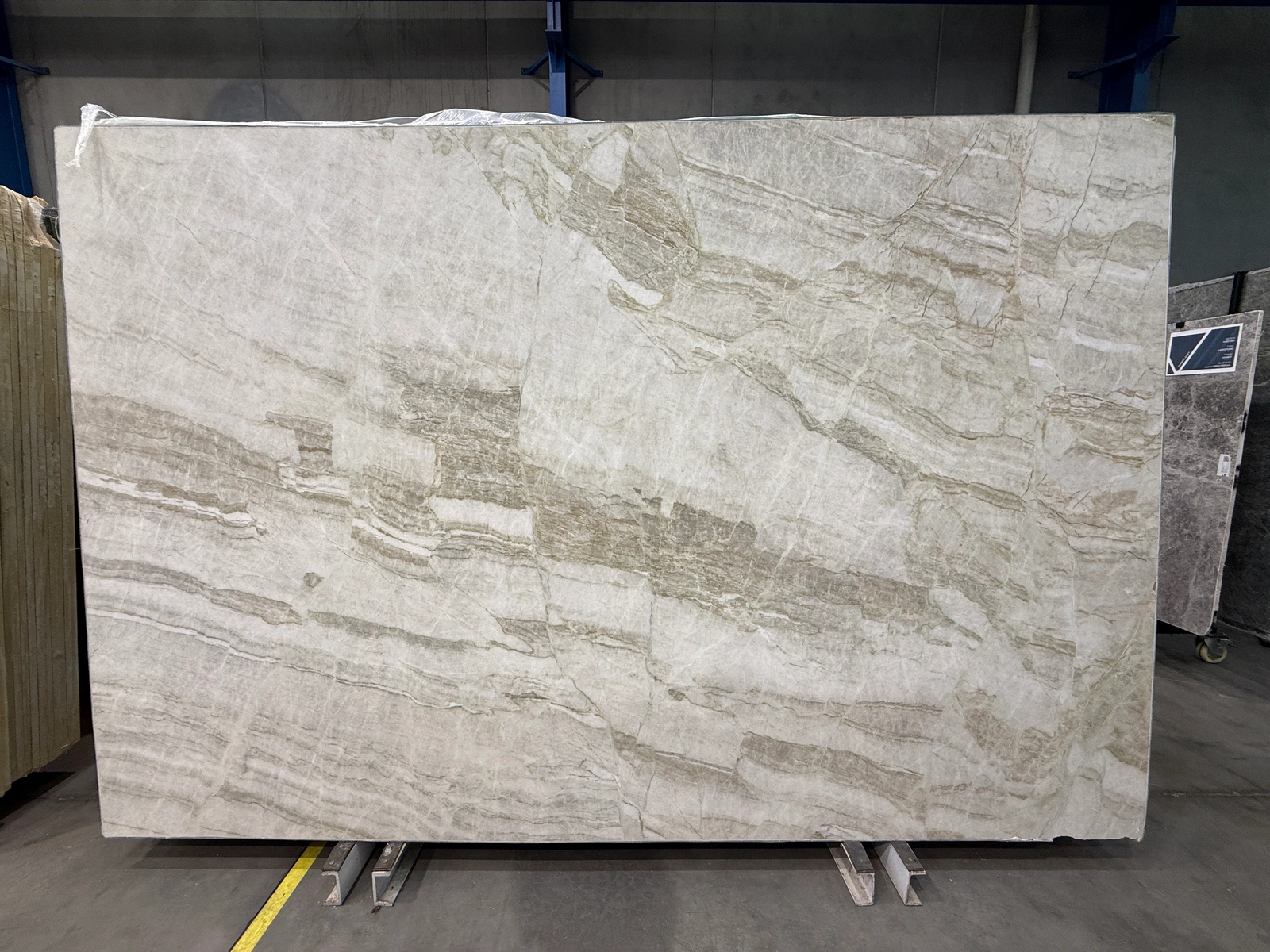
A warm, softly veined quartzite in cream and pale gold — one of the most requested natural stones in the gallery. Hard-wearing enough for kitchens, refined enough for anything, and held here in multiple finishes with every lot photographed individually.
Taj Mahal is quarried in Espírito Santo in south-eastern Brazil, the region that produces most of the world's exotic quartzites. It reaches Melbourne as full slabs, and we buy at the block so the lots in the gallery share a consistent character rather than being assembled from scattered purchases.
The background is a soft cream to pale beige, moved through with gentle gold and taupe veining that reads as texture rather than pattern. It is the stone people reach for when they want the calm of a pale marble without the marble. Tone varies between blocks — some lots lean warmer and more golden, others cooler and greyer — which is why the lots on this page are photographed one by one.
Kitchen benchtops and islands, splashbacks, bathroom vanities, and feature walls. Its density makes it a practical choice for the surfaces that get used hardest, and it is used outdoors in sheltered applications, though tone can shift with prolonged direct sun.
Quartzite is dense and comparatively forgiving, but it is still a natural stone and should be sealed on installation and periodically thereafter — your fabricator will advise on the interval for the finish you choose. Wipe spills rather than letting them sit, use a pH-neutral cleaner, and avoid abrasive pads. Our general care and maintenance guide covers this in full.
Quartzite. It is a metamorphic rock formed from sandstone, and its resemblance to a pale marble is exactly why it is so widely specified. The practical difference matters: quartzite is substantially harder than marble and far less reactive to the acidic things that etch a marble benchtop, such as lemon juice, wine and some cleaning products.
Three worth knowing. It is a natural material, so colour and veining vary block to block and the slab you choose is the slab you get — which is why we photograph every lot. It should be sealed, unlike an engineered surface. And quartzite is hard, which makes fabrication slower and more demanding than for softer stones; use a stonemason who works with quartzite regularly.
They are comparable on hardness and everyday durability. The difference is aesthetic: granite reads as granular and speckled, where Taj Mahal reads as a soft, veined, marble-like surface. Pricing for exotic quartzites generally sits above standard granites and varies by lot, finish and thickness — contact us with your project and we'll quote against what is actually on the racks.
It is one of the most popular quartzites for exactly that. It handles daily kitchen use well, resists etching far better than marble, and is heat tolerant — though trivets are still sensible, as sustained heat can affect any sealed stone. Talk to your fabricator about edge profile and finish before committing.
Yes. 30 lots of Taj Mahal quartzite are in our Dandenong South gallery as at 10 October 2026. Stock on this page is generated from our live warehouse data, so what you see is what is on the racks.
We currently hold Taj Mahal in honed and leather and polished finishes. Finish availability changes with each shipment — the lots listed above are what is here now.
Slabs run up to roughly 3.5 × 2.0 metres, in 20mm thickness. Natural stone is cut block by block, so dimensions vary between lots — each lot above lists its own.
Yes, and we'd encourage it. Taj Mahal is on display at 37–39 Gaine Road, Dandenong South, open Monday to Friday 7:30am–4:30pm and Saturday 8:45am–2pm. Every lot is photographed individually so you can shortlist online first, then view the slabs in person.
Choosing quartzite. Read our guide on selection, sealing and everyday care before you commit.
Quartzite Guide


