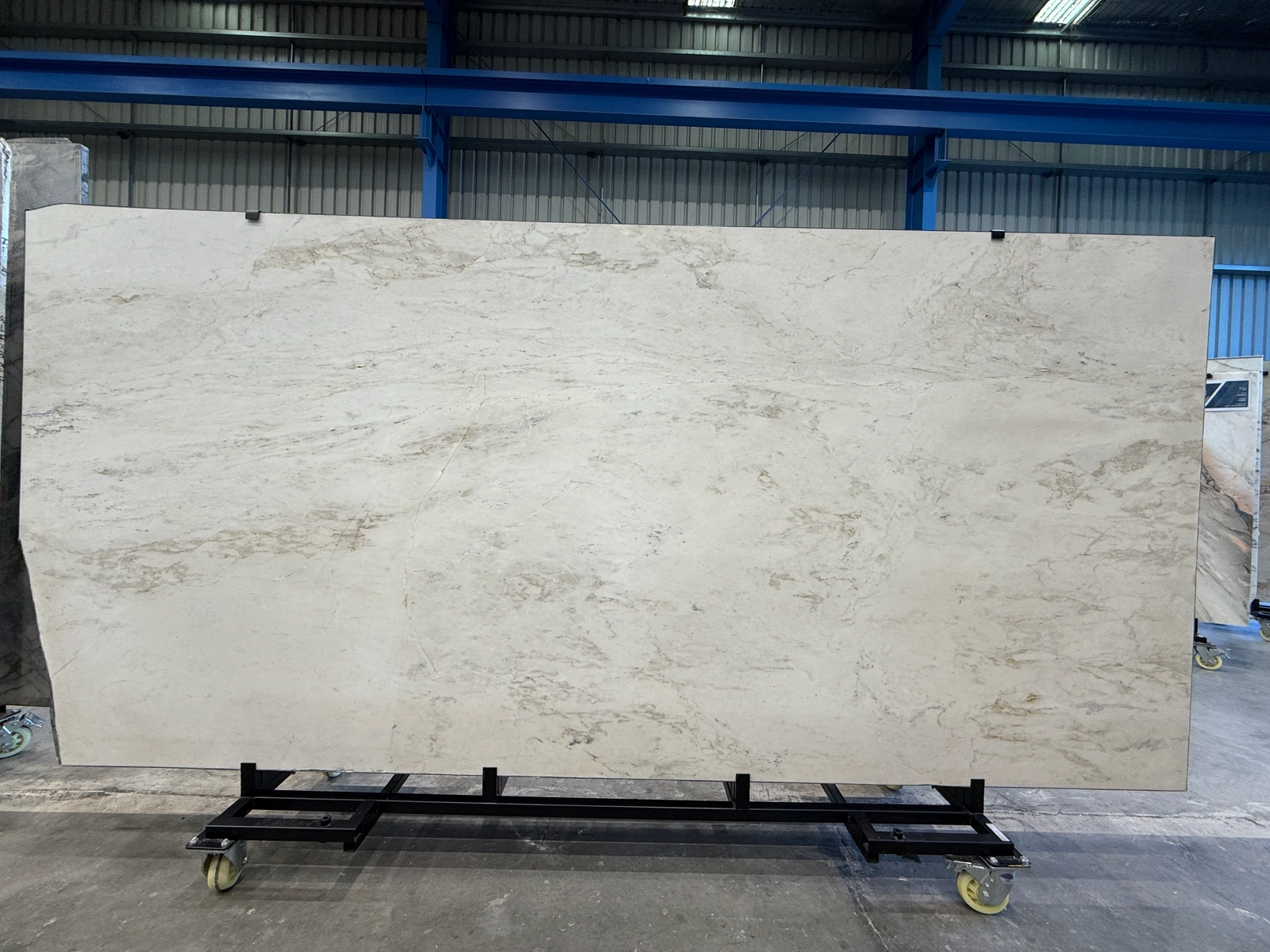
A Brazilian dolomite with a bright white ground and soft grey veining — the Calacatta look, in a stone that copes better with daily kitchen life than a classic Italian marble.
Quarried in Brazil, Calacatta Matarazzo Dolomite sits between marble and quartzite in hardness — chemically it is a carbonate, like marble, but denser and less reactive — which is why it is so often specified by people who want a Calacatta appearance without a marble's day-to-day concerns.
A clean white to off-white background with grey veining that ranges from fine and linear through to broader, more sweeping movement, occasionally warmed by a thread of gold or taupe. Blocks can vary — some lots read quiet and almost Carrara-like, others are far more graphic. Considering the variation, it’s important to select a lot with the look you are after, rather than the name of the stone only.
Kitchen benchtops and islands, splashbacks, bathroom vanities, feature walls and fireplace surrounds. Its density brings the white marble feel and look to a more practical hard-wearing option.
Dolomite is denser and less absorbent than marble, but it is still a natural stone: seal on installation and periodically thereafter, wipe spills rather than letting them sit, use a pH-neutral cleaner, and avoid abrasive pads. Our general care and maintenance guide covers this in full.
A dolomite. Dolomite is a carbonate stone closely related to marble, but with a mineral composition that makes it harder and less porous. In practice it looks very much like a Calacatta marble and behaves like a more forgiving stone.
Aesthetically they are close — a white ground with grey and occasionally gold veining. The difference is how they behave. The dolomite is harder and less reactive than a calcite marble, though still a carbonate stone — spills should be wiped rather than left, but it copes with everyday kitchen use more comfortably than a softer Italian marble.
Yes — it is one of the main reasons people ask for it. Seal it, use a pH-neutral cleaner, and treat it as natural stone rather than an engineered surface. Talk to your fabricator about edge profile and finish before committing.
Yes. Any natural stone benchtop should be sealed on installation and re-sealed at an interval that depends on the finish and how hard the surface is worked. Your fabricator will advise for the lot you choose.
Yes. 8 lots of Calacatta Matarazzo dolomite are in our Dandenong South gallery as at 10 October 2026. Stock on this page is generated from our live warehouse data, so what you see is what is on the racks.
We currently hold Calacatta Matarazzo in honed and leather finishes. Finish availability changes with each shipment — the lots listed above are what is here now.
Slabs run up to roughly 3.4 × 2.0 metres, in 20mm thickness. Natural stone is cut block by block, so dimensions vary between lots — each lot above lists its own.
Yes, and we'd encourage it. Calacatta Matarazzo is on display at 37–39 Gaine Road, Dandenong South, open Monday to Friday 7:30am–4:30pm and Saturday 8:45am–2pm. Every lot is photographed individually so you can shortlist online first, then view the slabs in person.
Choosing dolomite. Read our guide on selection, sealing and everyday care before you commit.
Dolomite Guide


